Bridging Distances
Music as a Connection Across Space, Emotions, and Time

In October 2024, I was invited to speak at the International Workshop “Distances: The Multidimensional Implications of Distancing,” organized by ISEAS Kyoto, Japan.
Drawing on my experience as a musician, I explored the many ways distance shapes artistic life: the physical distance between cultures and places, the emotional distance between artist and audience, and the temporal distance between past and present in music. Rather than seeing these forms of distance as barriers, I reflected on how they can become opportunities to build bridges, deepen connection, and open new creative possibilities.
I also spoke about technical distance: the space between creative intention and its realization in practice. Narrowing that gap, I suggested, is an ongoing journey of refinement, awareness, and artistic growth.
Geographic, Emotional, Temporal, and Technical Distance
When I began reflecting on the theme of distance, I immediately noticed how many forms it takes in my life as a musician: geographic distance, emotional distance, temporal distance, and technical distance.
And the more I thought about it, the more I realized how much Music can bridge those distances, creating opportunities for connection, growth, and artistic expression.
Geographic Distance
As a musician, I’ve been lucky to perform in places far from each other, from America to Japan, and across Europe.
Geographic distance seems like an obvious obstacle: different cultures, languages, and time zones.
In Europe, for example, there is a strong classical music tradition, which can sometimes be limiting, imposing rigid ways of understanding art.
Playing in Europe Thomas de Hartmann’s classical repertoire on archtop guitar tuned in fifths with a pick, as I do with a project I have with Bert Lams, might upset purists.
But in America, the audience is more open-minded, ready to listen without prejudice, willing to embrace something new.
This makes every concert a unique experience where music creates an immediate and deep connection with everyone, no matter where we are.
In Japan, performing Simple Music for Difficult People also created a deep emotional connection despite the cultural distance. I usually end my set with a song where I simulate Taiko drums on the guitar, and as an encore, I play the UltraSeven theme! Music, then, becomes a universal language that bridges the physical distances between people, bringing us closer and creating bonds beyond words.
Emotional Distance
One of the most profound distances I encounter as a musician is the emotional distance between myself and the people I play for.
That gap, however, becomes beautifully blurred during my house concerts.
In these unique settings, I’m not just an artist performing for an audience; I’m a guest, sharing a glimpse into the lives of those who host me.
For a day, I live with them: I see how they live, share meals, and sometimes even exchange life stories. One day, my host might be a high-level HR executive from Apple, and the next, a modest but deeply passionate family who pours their heart into everything they do. This range of experiences offers me a privileged perspective and it breaks down the emotional barriers that might otherwise exist in a typical performance setting.
In those intimate spaces, the music becomes a bridge, drawing out conversations and connections that go beyond the notes I play.
In that environment, there’s no stage, no distance… just a shared, heartfelt moment that we both get to live fully, even if just for an evening.
Temporal Distance
Some of the music I play is rooted in the past.
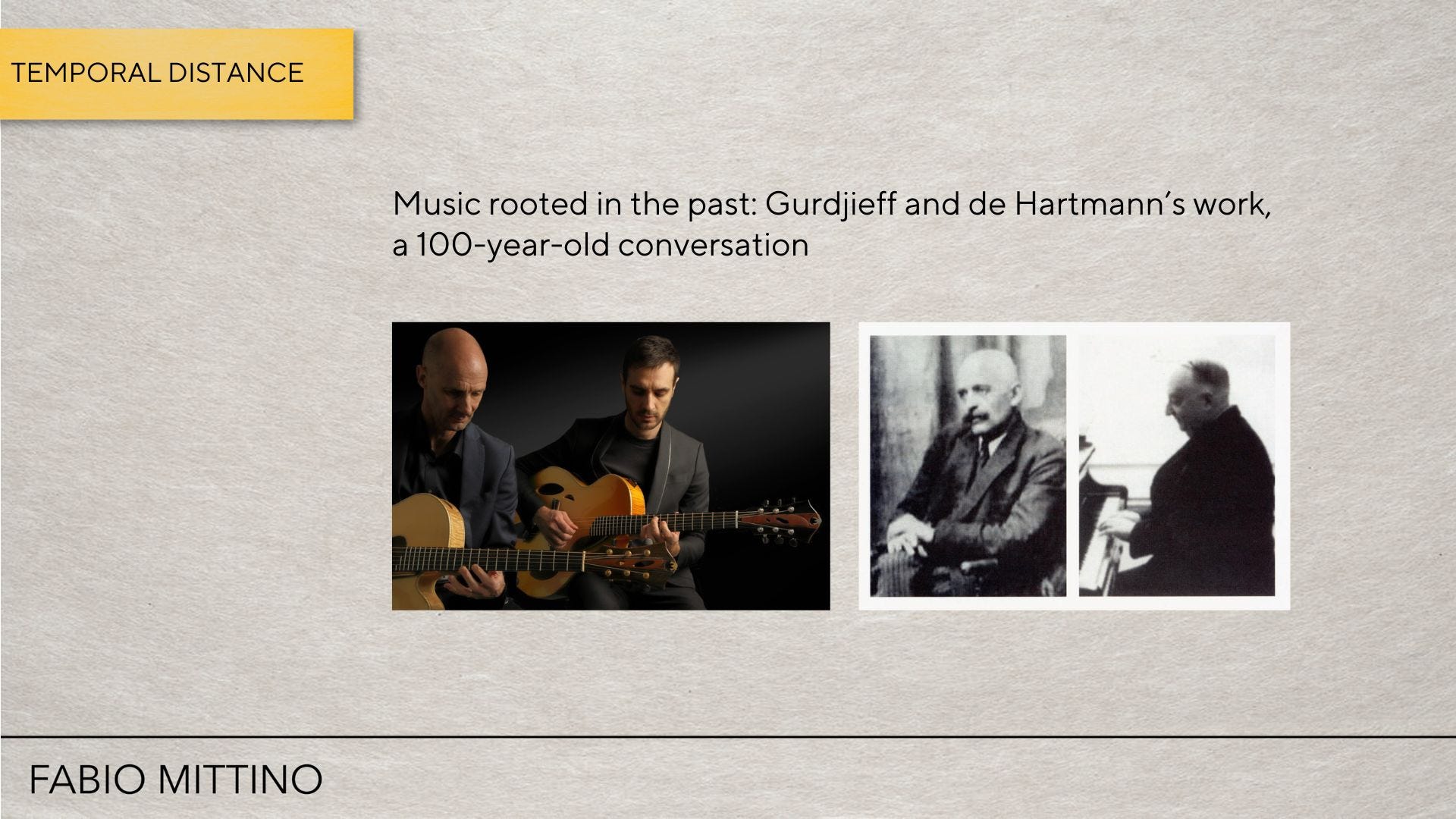
This is the case with the work I’ve done for 20 years with Bert Lams on Gurdjieff and de Hartmann’s music.
It was composed about 100 years ago, but it feels close to me.
I find it fascinating how we can bridge this 'temporal distance' through deep study, interpretation, and performance. When I play music written centuries ago, I don’t feel disconnected from those composers. I feel like part of an ongoing conversation that transcends time and space.
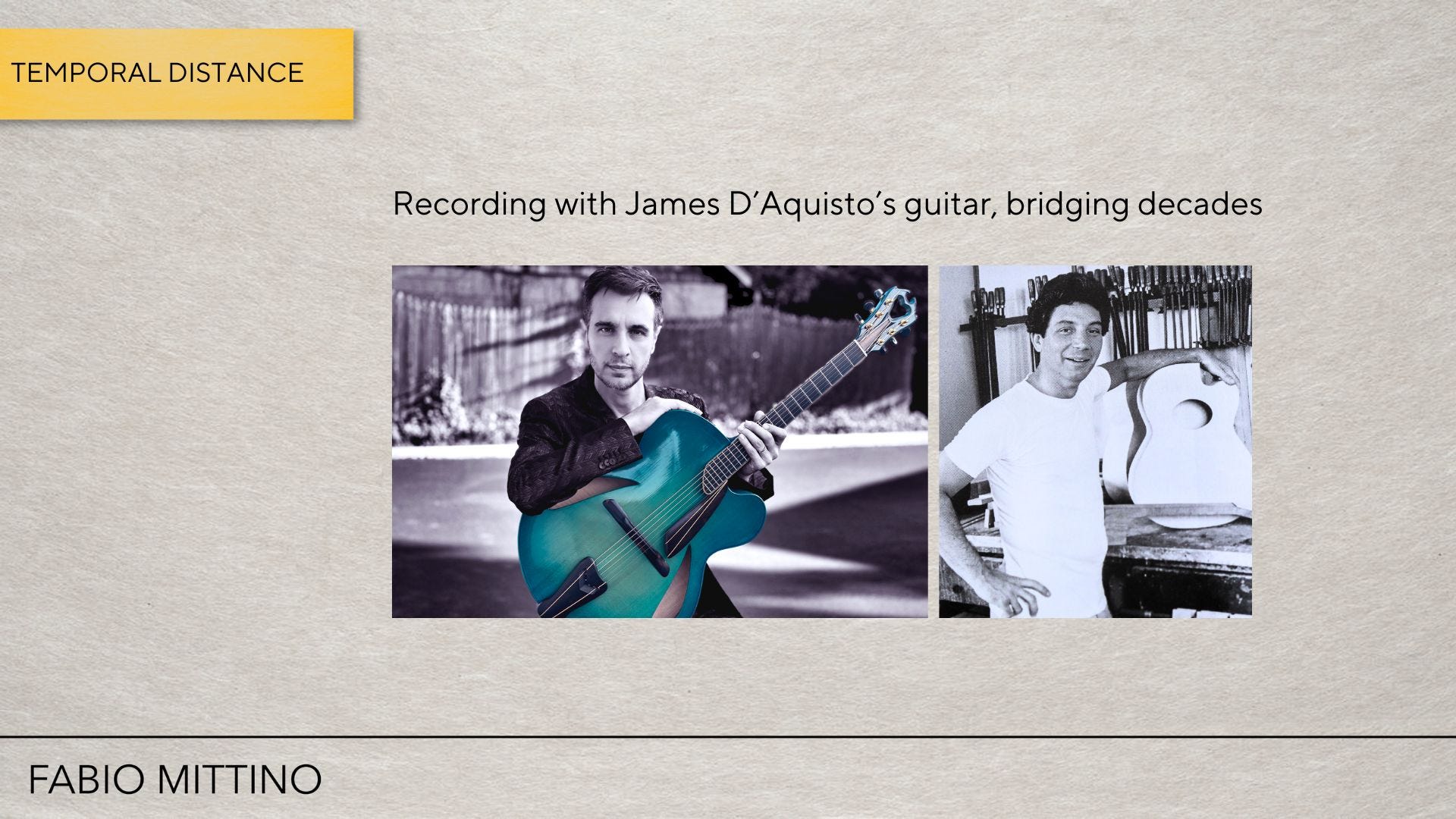
Another example was when the Canadian Archtop Foundation let me play a magnificent guitar built by James D’Aquisto, known as the “Stradivari of guitars”.
I flew to New York to record my solo album, and I played it almost non-stop for four days.. that’s all the time I had to make the album!
The guitar had been in a vault for 20 years, but by the second day, it started to open up, with a deeper sound resonating beautifully.
I could feel the passion of Jimmy D’Aquisto, and -humbly- I liked to imagine that he would be happy to see his guitar in action again.
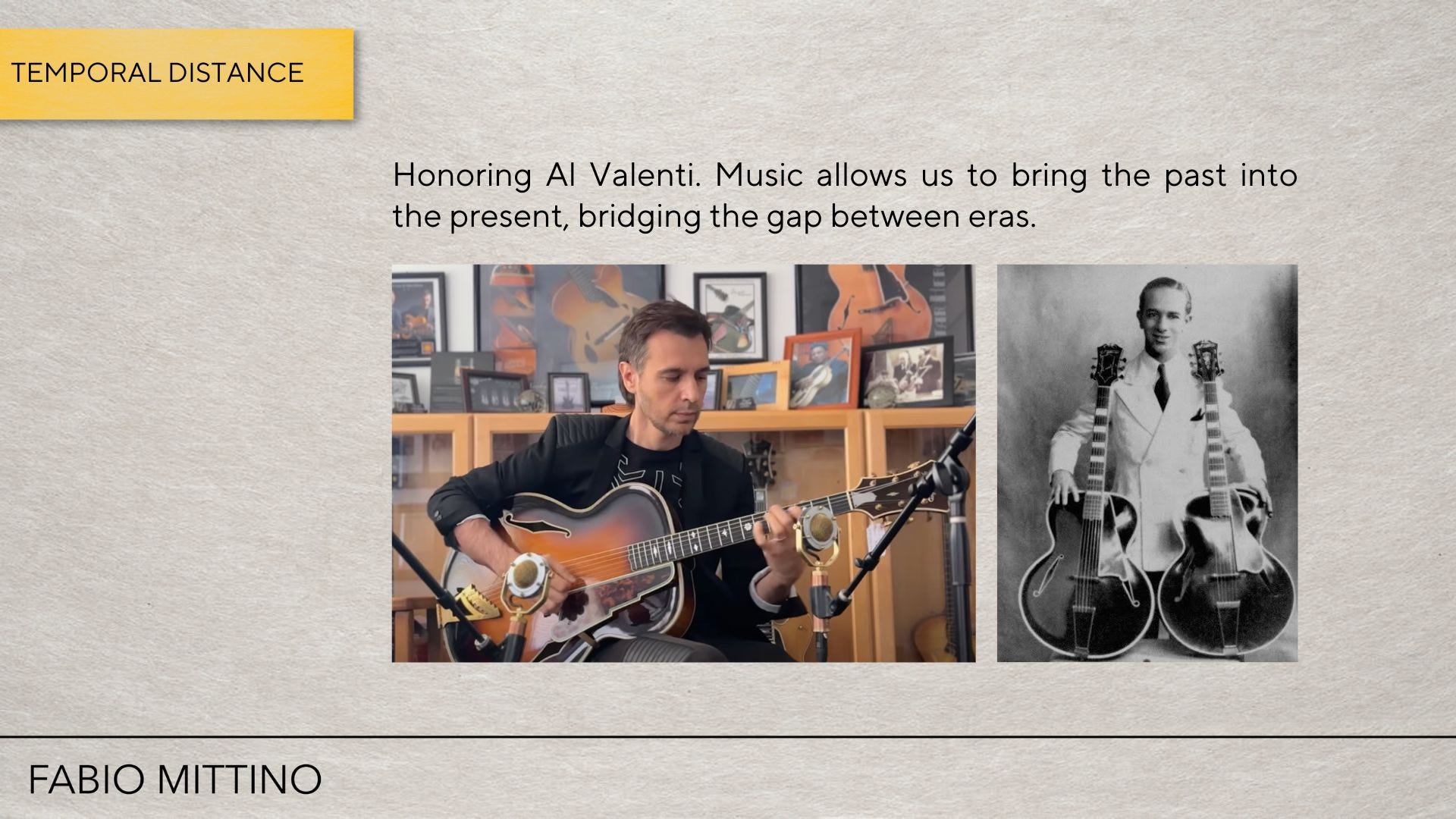
Another world famous luthier, John Monteleone, gifted for me for the occasion a transcription of a guitarist from the ‘30s, Al Valenti, which I reinterpreted with great dedication.
It was a complex piece, so I prepared for about a month. In the end, it felt like I knew Al Valenti, as if he were a close friend.
Technical Distance: From Intention to Execution
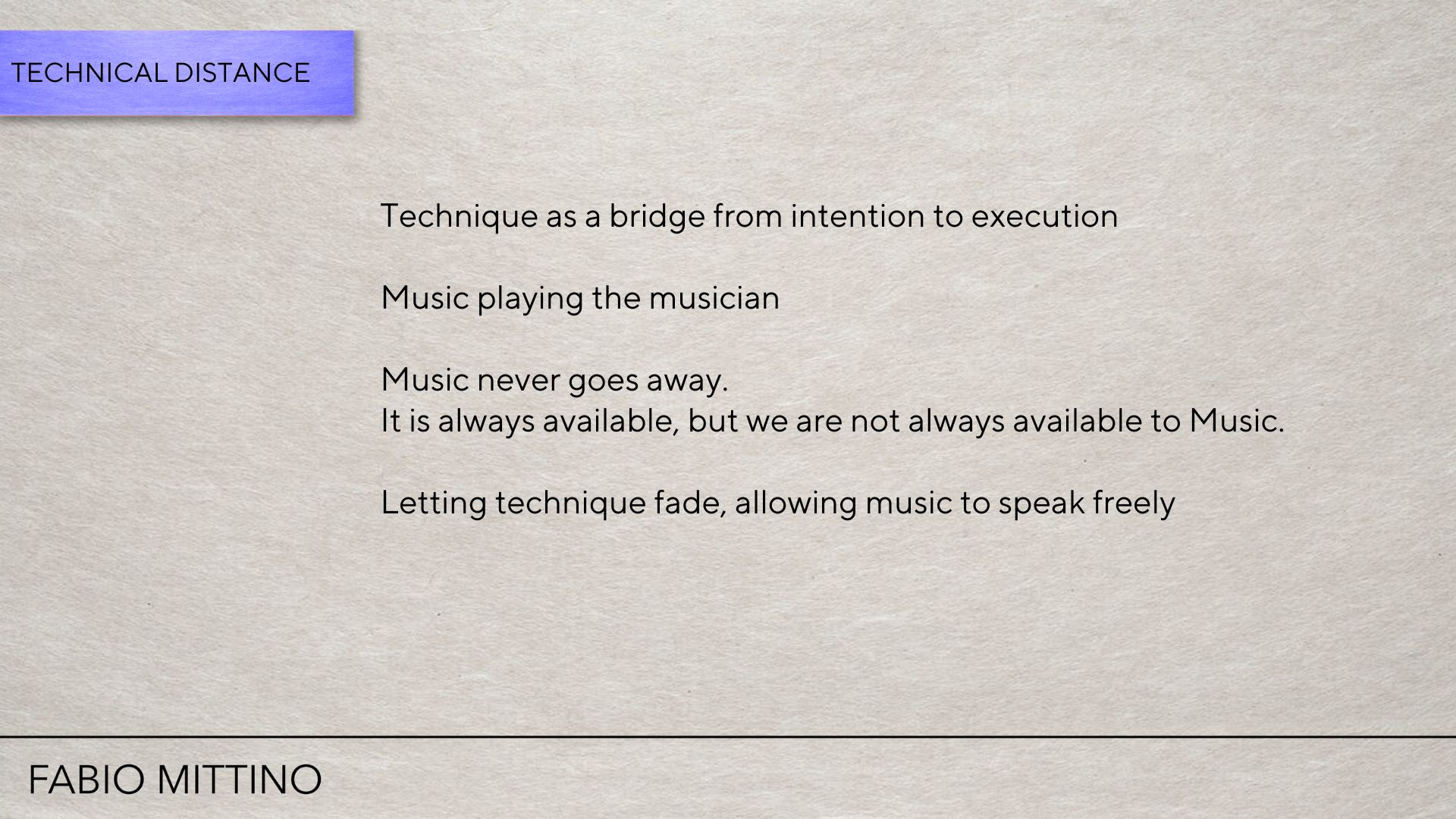
Technique is the bridge that brings us closer to what we hear in our heads and feel in our hearts.
We often think we’re the ones playing the music, but the truth is, it’s the Music that plays the musician.
For this reason, better be ready and prepared. Spiritually, mentally, and physically.
Technique is one of the element that closes the distance between Music and musician. With enough practice and attention, technique fades into the background, allowing the music to take control and lead the way. So, when we work on technique, we’re not just getting better at playing; we’re preparing ourselves to step back and let the music speak freely and authentically
In the end, distance is just an illusion. When we allow ourselves to be moved by Music, we’re no longer separated by time, by people far away, or by what we feel we need to express. We’re all connected through time, through space, and through the beauty of shared intention.
And perhaps, this is the true magic of Music: it brings us closer, even when everything seems so far apart.