

There is a question that keeps coming back to me, especially when I look at the way people talk today about music, art, visibility, and success: what are we really measuring when we measure everything?
A useful place to begin is with a book published in 1945, which I strongly recommend: The Reign of Quantity and the Signs of the Times by René Guénon.


In that book, Guénon criticized what he saw as a modern drift toward an increasingly quantitative view of reality: a mindset that reduces everything to numbers, measurement, accumulation, and statistics, while gradually losing contact with quality, meaning, and the inner, symbolic dimension of human experience.
Read today, that thought feels even more striking… poor René! One wonders what he would think if he saw the world today!
Because if Guénon could already see, back then, the danger of a civilization replacing meaning with measurement, today we live in a world in which almost everything seems to require a number in order to be recognized: followers, subscribers, streams, tickets sold, views, ratings, box office revenue.
I’m not saying that numbers are useless, but I believe we have started to mistake numbers for proof of value:
More followers, therefore more success.
More streams, therefore more talent.
More views, therefore more relevance.
More revenue, therefore more quality.
But it does not work that way. And very often, it is simply not true.
Number as a mental shortcut
Numbers are easy to read, easy to compare, and reassuring for anyone who has to make decisions quickly. A number appears objective, neutral, definitive. It saves you the effort of judgment. It saves you the time of listening. Sometimes, it even saves you from doubt.
The more I pay attention, the more I notice this way of thinking everywhere. It has spread far beyond younger generations and it has shaped the broader cultural imagination.
Paolo Villaggio, a famous Italian actor and writer, once expressed this in a particularly blunt and memorable way during a Rai interview in November 2008. Though best known for comic roles, he was often deeply lucid in his cultural observations. Speaking about television, he said:
Today, much of television, like Cinepanettoni (note: It’s kind of like a cheap, vulgar, predictable holiday comedy franchise made for the holiday season), is produced only with success in mind.
Many programs—and those of you who work in television should pay attention!—are built only around ratings, around being accepted by the public in some way.
And the public is willing to accept very low standards. So the more shit you give them, the more the ratings go up.
And so television, which has an enormous cultural responsibility, is becoming average-to-low-level television. And that is dangerous.
What strikes me is not only the harshness of the statement, but its accuracy.
Have you noticed that people rarely ask whether a film is good or bad anymore?
The conversation tends to focus on how much it cost or how much it earned. As if a multimillion-dollar budget guaranteed quality, or a box office record settled the question of value.
The same thing has happened with ratings.
At a certain point, the conversation stopped being about what a program was, what it said, how well it was made, or what kind of cultural contribution it offered. Instead, it became about its share. Program X reached a 7% share. Program Y beat it with 13%.
But were those programs good? What were they about? Did they elevate the conversation, challenge the audience, offer insight, beauty, or intelligence?
That no longer seems to matter very much. The content itself becomes secondary, what matters is whether it performs. You could almost broadcast a grey screen with static noise: if it managed to capture attention, it would still count as a success.
And this is the key point: that number tells you how well a piece of content fits the system that distributes it, it does not necessarily tell you how much it is worth.
When content becomes only a means
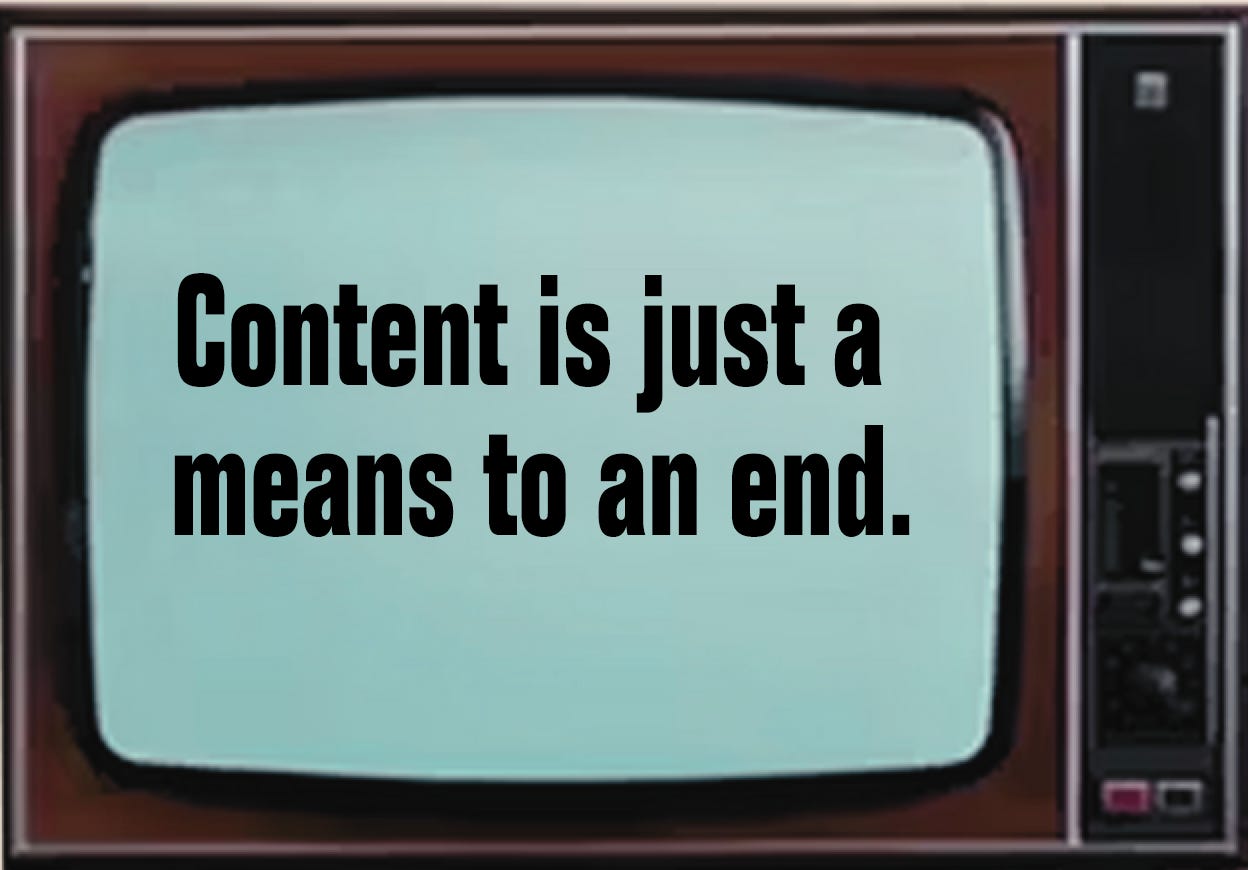
This is where, in my view, the real problem begins.
For many platforms, content is no longer the end. It is the means. It exists to hold attention, generate engagement, and keep people inside the mechanism. The goal is not to reward what is deeper, richer, or more meaningful, but what keeps the machine running.
Instagram, TikTok, Facebook, X… these platforms are competing, ultimately, for one thing only: your time.
It does not really matter what you are looking at, as long as you keep looking.
Doomscrolling is the clearest expression of this logic: a continuous stream of stimuli designed not to nourish you, but to retain you. And once retention becomes the dominant criterion, what wins is not automatically what has more quality. What often wins is what is faster, more reactive, more simplified, more emotionally immediate, more easily consumed.
In that kind of environment, a long, complex, thoughtful, refined piece of work may be disadvantaged from the outset, not because it is less valuable, but because it is less compatible with the logic of the system.
In music, the paradox is especially clear
Years ago, when I was workind as Artist Production Manager at the Blue Note Milano, the head of the jazz department at Universal Italia told me something I have never forgotten. He said that in meetings they were talking less and less about songs and more and more about music content. That expression alone says a great deal.
A song is a work.
“Music content” is a unit meant to circulate.
Once that shift happens, the question changes. What matters is no longer only whether a piece is beautiful, necessary, original, or artistically successful. What matters is how much streaming it generates, how much traffic it produces, how much it contributes to overall volume.
It is a change in language, yes. But before that, it is a change in vision.
And I firmly believe language matters, because language reveals what we are training ourselves to see.
When a song becomes content, art becomes inventory.
When visibility becomes the main criterion, circulation starts to look like value.
And when circulation is confused with value, we begin losing the ability to recognize quality for what it is. That, to me, is the real risk.
Because numbers are useful: They can tell us many things, how widely something travels, how quickly it spreads, how efficiently it fits the channels through which it is distributed, but they cannot, on their own, tell us whether something is profound, necessary, honest, or beautiful. And if we forget that distinction, we end up living in a culture where the measurable gradually replaces the meaningful.
So next time we need to assess the value of something, let’s remember not to be swayed by quantity, but to look for Quality.
Please subscribe if you liked this article.
See you next Wednesday with a two-part article about picks!
Excellent points.